

As I noted in the previous review, when the augmented reality game Pokemon Go first came out, I mostly heard about it from its biggest fan: John Ringo SF Author.
Like every good author, Ringo took something from his life, and weaponized it for a novel.
Being a John Ringo novel, that means weaponizing it literally. From the first book, Into the Real, written with Lydia Sherrer, they took Pokemon Go and turned it into Ender's Game.
Because in Pokemon Go, the augmented reality monsters can’t kill you.
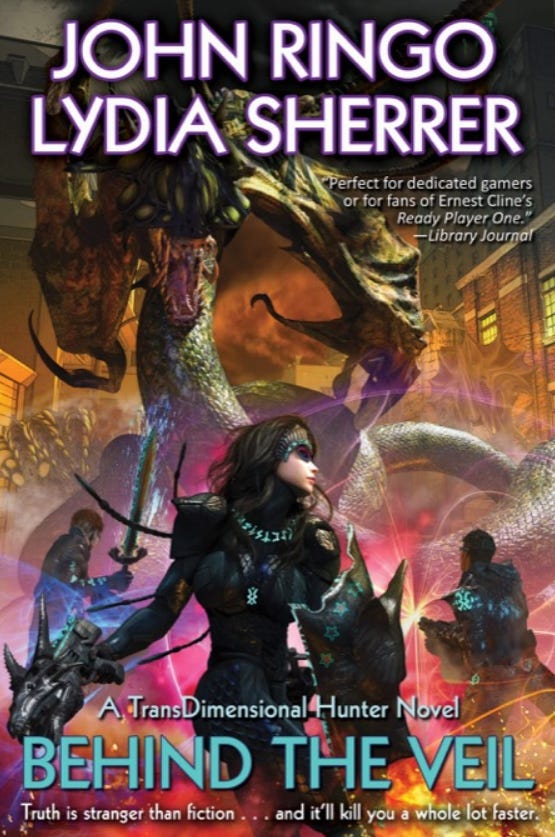
The story
In book two, Through the Storm, gamer Lynn Raven led her team to victory in a multi-team boss battle. Now, it’s time for the national TransDimensional Hunter championship, and they have to level up in a hurry to be up for the challenge.
As the story unfolds, Lynn finds some odd coincidences. The in-game monsters congregate around power terminals that often glitch … but when her team wipes out the monsters, the problems are miraculously solved. Growing power outages threaten transportation around the world. The homeless who dwell near monster spawning grounds drop dead, seemingly out of nowhere.
But while gaming may be strenuous, it is relatively easy compared to dealing with the real life threats that come her way. Seemingly all at once, Lynn has to fend off deep fake videos, doxxing, and a stalker. Fighting augmented monsters is almost preferable—all they can do is kill her.
The truth may set her free … hopefully, before it destroys her.
The entire TransDimensional Hunter series works on multiple levels, from Lynn’s personal challenges in-game and in real life.
I have enjoyed this entire series to date. Aside from a brief, odd subplot in Through the Storm, I can’t think of a single quibble I’ve had with the story. Each book builds very neatly and logically on the book before it. While book one and two were heavily character driven, book three is where the plot kicks in—the nature of the threat is explained in more depth, as well as the consequences of failure.
This is the third review in which I compared this series to Ender’s Game, but there is clearly a bit of overlap in the basic premise. And frankly, this is at minimum equal to Card’s work, if not better. Is it fair to compare a series to a single novel? Probably not. But I didn’t know there were rules for writing reviews.
I have seen some people complain that “this series doesn’t feel like John Ringo wrote any of them.” I genuinely don’t understand the complaint, since they feel enough like Ringo novels to me, and better than some.
The characters
Once again, Lynn Raven is an unusually likeable teenager. The daughter of a widowed single mother, Lynn has long ago monetized her video game exploits, generating a steady income via microtransactions. She is smart, capable, and even her foibles are relatable. And like the last book, it is also fun watching Lynn's personal character develop. She seems to be fully growing into her final form.
Lynn’s teammates are becoming more developed, each with an interesting character arc and background I don’t remember from the first two books. The team is coming together, and as a team, they are less willing to put up with BS, from classmates, bullies, or school administrators. It’s like the 17 year olds are becoming adults. Imagine that.
Even her mother has an interesting development in this one.
We still have Hugo, the AI that comes with TransDimensional Hunter game… basically Jarvis from the MCU. It is an entertaining character, and clearly more than what it appears.
We spend more time with Lynn’s handlers in video game technical support (who are SpecOps assigned to the game), as well as Mister Krator, the game designer himself, and his own machinations to save the world. Also, one member of tech support becomes more of a character than I would have guessed.
Even the human antagonists have developed. Funny enough, one becomes even more of a psychopath, and another starts becoming something resembling a human being. It’s strange enough that this series has teenagers who can pass for human, nevermind having a high school bully that’s well-developed, or have a character arc.
Overall, I like the characters and their development. Any annoying qualities from the previous books have been burned away in the crucible of the games. We have a touch of a romance subplot or two, but neither one really gets in the way of the action.
The world
Book one was largely setting up the game, and two was developing both characters and the world. Book three is more where everything comes to a head. This one leans heavier on character, and the world-building involved leans heavily on the overall story, with elements that even the characters have yet to figure out.
The politics
No. If you want, you can find some politics in here. But no.
Content warning
On the one hand, no content warnings. None. Not really. No torture. No rape. No sex of any kind.
On the other hand, however… the stalker gets sexual in expression, but there is nothing graphic. There is a mention of a pornographic video.
There is of course, lots of monster killing.
But from what I’ve heard from the current YA market, this is pretty PG. I don’t even remember much in the way of colorful language.
Who is it for?
This is for people who read Ender’s Game and wished there could be more actual gaming, and for people who would like something they can enjoy, and then pass on to adults or teens alike.
It puts some great new spins on the YA genre and the tropes within.
Why read it?
Ringo and Sherrer have created a modern day Ender's Game using the technology of Pokemon Go. The characters are vivid and interesting, and the plot is strong enough to carry you along the entire way.
I'm reading it right now. It's an amazing series. John Ringo and Lydia Sherrer are very different authors (and I really like them both), but they've come together to make a series that I don't think either could have done solo. Looking forward to the conclusion, and I hope they revisit the setting!