

I’ve been greatly enjoying the Christopher Nuttal Schooled in Magic series. It has one of the best-developed worlds I’ve seen in quite some time, with rigorous, effortless world building that never really stops. We’re four books in, and there’s always more to discover.
As for our protagonist Emily, she always has more to reveal.
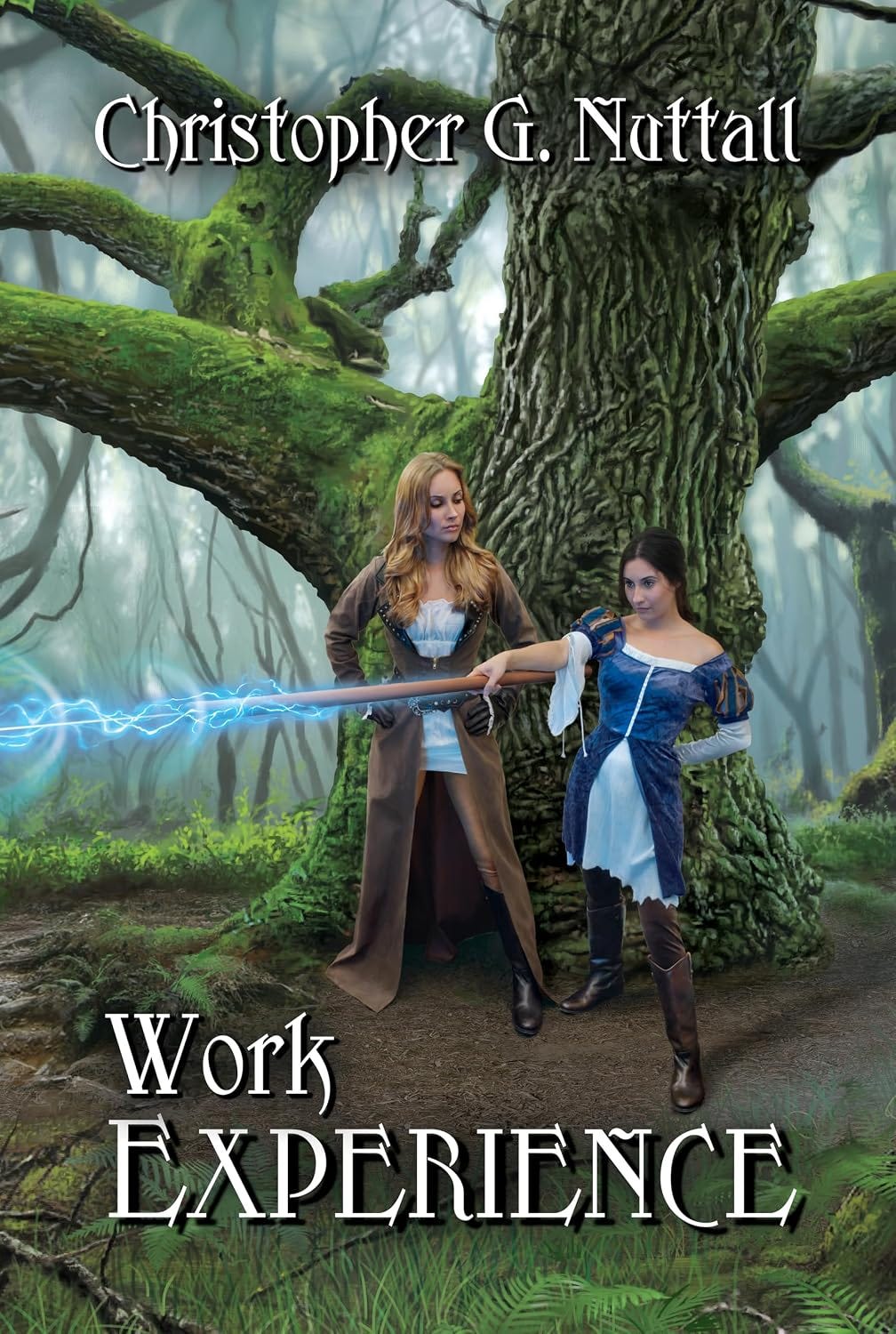
The Story
It has been two years since Emily was taken from our world into a world of magic. In her first summer vacation, she survived a royal coup. Then she had to stop a wholesale slaughter of the school… again.
Before she leaves Whitehall for the summer break, her sponsor, Void—the White Council black bag operator— has reported that a necromancer has been killed, and no one knows who did it.
This summer, Emily is working with her mentor Lady Barb, wandering the countryside to fix any and all medical problems that they can … and any other problem that crops up along the way.
One of those problems include missing children. The immediate suspect is a necromancer. Except necromancers are insane and out of control, so if it’s a necromancer, how is it keeping a low profile?
And if it is a necromancer, how can Emily and Barb even hope to stop it by themselves?
While previous books have shown just how brilliantly developed this world is, this is definitely the book that highlights that this is the magic school genre for adults. While Emily has spent her time in academia or among royalty, she’s plunged into a day-to-day world where being in a small town does not translate into a community.
The solution here has been something built up since at least book two, if not book one.
Work Experience also does a nice job of setting up not only book five, but six and seven as well. And there’s at least one other omnious threat lurking in the background, who can easily kill a necromancer without a sound, and they cause the rise of another major threat.
The Characters
It’s nice to see Emily’s character develop over time. She’s gone from being dead certain that her technological advancements would improve the world, to remembering that some of those improvements came at a price. Now, she gets to see just how much she’s been living in a bit of a bubble. It’s interesting that over time, we get to see more of her flaws, not fewer. Especially since she was so focused on building a new life, she never really dealt with the scars of her old one.
Lady Barb is also an interesting enigma. She had natural gifts as a medic, but chose to be a combat sorceress. Her background is a complex mess of contradictions. And Nuttal is taking his time showing us all sides of her. It’s also interesting watching conversations with Emily as Emily realizes that she has all the choices for her future, when Emily started this series thinking she didn’t have a future.
The World
Work Experience is the novel that shows us even more of the world, away from the world of magic and the world of royalty. And it is not pretty. This isn’t our world’s idea of rural communities. It is a world without Christ, and little better than the world of antiquity, but without the human sacrifice, since that’s the realm of necromancy. But life is still cheap. While the serfs of the post-classical world1 may not have been treated the best, they still had rights; here, the average subject is treated little better than slaves. The strongmen in charge can get away with almost anything. Children are treated like dirt, and killed at a whim—another pre-Christian staple that this world has not been rid of. And gifts are never gifts, but ways of indebting people to each other.
Readers are also allowed to see wizard networking, healthcare, and politician wrangling.
Also, the magic system is still fun, playing with magical concepts, and delving into theoretical thaumaturgy, as well as letting magic being magical.
Politics
None
Content Warning
This book is definitely more PG-13 than the previous books. While nothing graphic happens, there is discussion of sexual assault, child abuse, an aborted rape attempt, child kidnapping, necromancer human sacrifice, etc. While it’s about as graphic as The Lord of the Rings, Tolkien never touched on some of this in as much detail.
No, there is no orc cannibalism yet, but we haven’t had those particular monstrosities since book one.
Oh, yes, there is one character who is gay, but it’s touched on so little, I suspect its inclusion was the only way to make the plot work.
Who is it for?
If you liked magic schools like Harry Potter, this is more magic schools.
If you thought Harry Potter needed more maturity and more world building, here you go.
If you want the epic scope of Tolkien, you should also be reading this series.
Nuttal basically has all the hallmarks of good fantasy. It’s less ethereal than Wright or Gene Wolfe, but still epic.
Why buy it
This is Harry Potter for adults. It’s just criminal that it doesn’t have the JK Rowling hype machine behind it that Harry Potter ever did.
“Medieval” or “Middle ages” were slurs meant to deride the era after the wall of the western Roman Empire.