
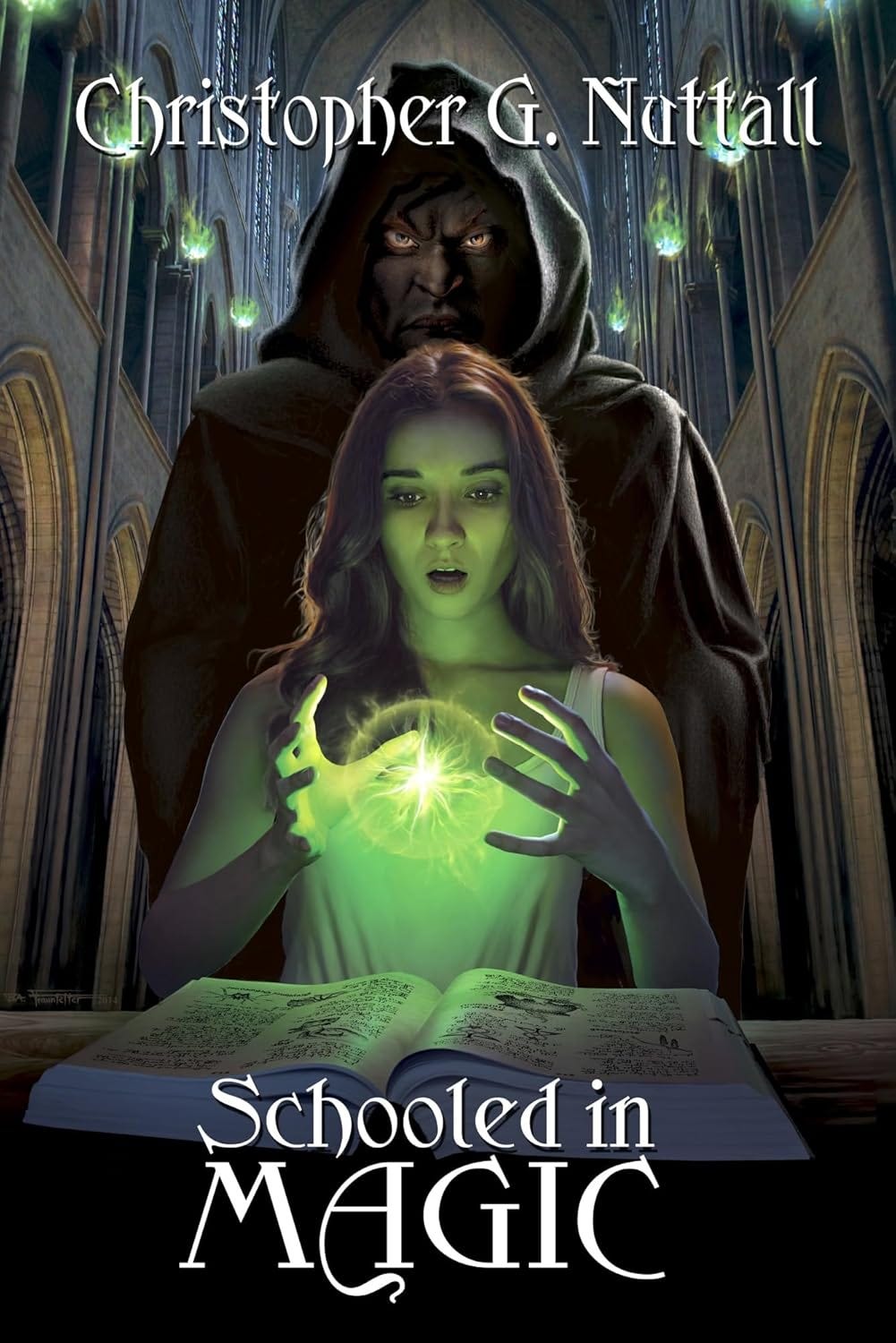
Book Review: Schooled in Magic, by Christopher G. Nuttall
Some people get an owl or Gandalf at the front door—Emily got a necromancer.

While I had heard the name of Chris Nuttall from time to time—and even contributed to a few of his anthologies—I had never read any of his novels. So when Schooled For Magic came up for sale, I thought I’d give it a try. What was the harm?
The Story
Some people get an owl or Gandalf at the front door—Emily got a necromancer.
Emily Sanderson leaves the library, meditating on her miserable life. Between footsteps, she finds herself in another world, with a necromancer ready to sacrifice her. A second sorcerer named Void—having detected an incursion from another world—drops in and rescues her.
The necromancer, “Shadye,” had asked the fae for a Child of Destiny. Emily’s mother? Is named Destiny. At least the fae are consistent.
While Void can’t send Emily back home, he does sense that she has magical potential, and the Grandmaster of Whitehall, the local magic school, owes him a favor.
What follows is a deep dive into a whole new world, and Emily’s impact on it. And the ending is a shootout so epic, it’s hard to imagine what comes next.
Schooled in Magic is a surprisingly epic, self-contained novel, despite being the start of a series. The characterization is efficient and tightly written, very “David Weber Orders a Pizza.” The world-building is more thorough than you’d expect; I suspect it’s Tolkien deep, but Nuttall doesn’t want to bury us, only covering what’s needed for the book to keep going.
Of course, Schooled in Magic addresses all of the standard tropes of the boarding school novel, even developing his own sport—which Emily is not good at, does not understand, and doesn’t want to. I appreciated it, but only because I know where the tropes come from. No. Nuttall swapped out sports for martial magic. And surprise! martial magic is all about fighting, surviving, tactics, and endurance. It’s almost like someone understands what’s required in defending oneself against the dark arts or something. And when magic goes wrong … my God! The adults understand, and use it as a teachable moment!
We of course also have the trope of the school bully, which Nuttall executes far more elegantly than anyone I’ve seen in a while. Readers had to wait for George MacDonald Frasier to make the bully of Tom Brown’s School Days into a fleshed out character.1 Here, we have character motivations and everything.
The meta humor is much appreciated here. Even in chapter one, where she “thought of all the fictional heroes she’d known and loved, asking herself what they would do. But they had the writer on their side.” When doubting her abilities in this new world, she ponders, “What was she going to do? Impress Shaye by her masterful grasp of role-playing games, creative writing, and wasting time browsing the internet and reading web comics? She didn’t even have a homicidal rabbit with a switchblade on her side.”
Taking “the chosen one” trope and turning on its head with the “Child of Destiny” bit was such a nice little twist. And it keeps playing out over the book.
By the end of the book, every piece of worldbuilding, character, and plot come together in the final throwdown in one of the neatest bits of writing I’ve seen in a while.
Schooled in Magic is like Lamplighter’s Rachel Griffin novels, in that it makes my head hurt to think that JK Rowling sucks all the air out of the room. Had I read this before the Harry Potter novels, I would have thought that Rowling was the pale imitation.
Despite reading all of the Harry Potter novels, I only ever kept the last one. I’m already debating if I need to get the entire Schooled in Magic series in hardcopy.
The Characters
Christopher Nuttall pays great attention and spends a lot of care on each of his characters. The introduction of Emily tells you everything you need to know about her by the end of page 2. And watching her develop from depressed teenage bookworm to magical academia is pleasant. Heck, she’s a teenager who isn’t annoying, making that an achievement all by itself.
Emily also has real empathy, where she goes out of her way to model her mind one someone else’s in order to understand how they think. I don’t see that much.
Almost every student Emily interacts with gets what feels like full biographies in a matter of a few pages. From the roommate who’s a shopkeeper’s daughter to the mean girl who really is a princess.
Even Void is summed up by himself.
“I’m a bad teacher. I’ve had seven apprentices in my time. Three of them had to be dismissed … two died in magical accidents, one went rogue and became a necromancer…. I had to kill him. Suffice it to say that my history of tutoring apprentices is not good.”
Most of the professors don’t get quite as much development as other characters, but even that’s hiding at least one plot twist.
The World
Schooled in Magic is a vivid, highly developed world, where both necromancers and royal kingdoms alike are kept apart by petty bickering. And watching Emily disrupt entire political systems with little things like modern numerals, bras, and “Has anyone heard of the stirrup?” And she spends so much time thinking about how little she knows about how things work. But on the flip side, it’s interesting with this world and its expressions of things we understand—like making certain the water is boiled to kill the “invisible devils in the liquid.”
Oh, yeah, and it’s so nice to have someone use classes for world building. Not “here’s a clue in this particularly mystery of the week,” but a class that explains to the reader not only the history of the world and the governing bodies, but how the world has gotten to this point over centuries. It’s also critical to the plot, but everything in this book turns out to be critical to the plot.
The magic system here is surprisingly impressive. To start with, this may be one of the few magic worlds that actually address “where magic comes from,” and how one exercises it. Most people when explaining magic stick to one allegory, but while Emily starts by understanding the most basic spells as binary, (with some people as Script Kiddies) it even surpasses that understanding. And parking Whitehall on ley lines was an interesting tidbit that turned out to be key to the plot.
Also, speaking of magic.
“One idiot girl, having brewed a potion to make herself look like another girl, had made the mistake of using a cat hair as the source of genetic material. She’d turned herself into a cat-girl from a comic book, at least on the surface; inwardly, she’d warped her body so far that recovery was impossible. The poor girl would forever remain one of a kind, a strange hybrid of human and cat.”
Cough. Can’t imagine where Nuttall got that idea from. Cough.
The academics at Whitehall are practical and straightforward, from charms to “martial magic”—where the professors are Sergeants and the department head is a general. I even like the tactics.
This is even one of the better thought-out language models. Not John C Wright’s Somewhither good, but better than almost everyone else I’ve read.
Also, it’s nice to have someone address laws about turning random materials into gold.
Nuttall even redesigned chess.
Politics
There are no real politics in this world, unless you consider basic economics or corporeal punishment as political.
If that level of “politics” set you off … seek help, man.
Content Warning
If you’re set off by caning teenagers for being idiots, then there, that’s your content warning. I think it still only brings it to a PG at most—a modern day PG, not a 1980s PG.
Who is it for?
This really is for anyone who wants a well written epic fantasy novel. I think even calling it for people who are fans of magic schools is too narrow. Do you like Harry Potter, then sure, read this. But if you like Narnia or Tolkien, you’re going to love this.
Why buy it
It’s just amazing. And Schooled in Magic seems to be permanently at $0.99. Take the risk. I think you’ll be glad you did.
Harry Flashman
A positive comparison to the Rachel Griffin novels has me sold. Those are some of the BEST fantasy I've ever read. There is a sense of both wonder and joy woven throughout.
While there are 28 sequels, IMO Chris does a good job of having each story stand on its own.
Mind you, there's a couple of times where the story has to be "split" into two books but he does it well IMO.